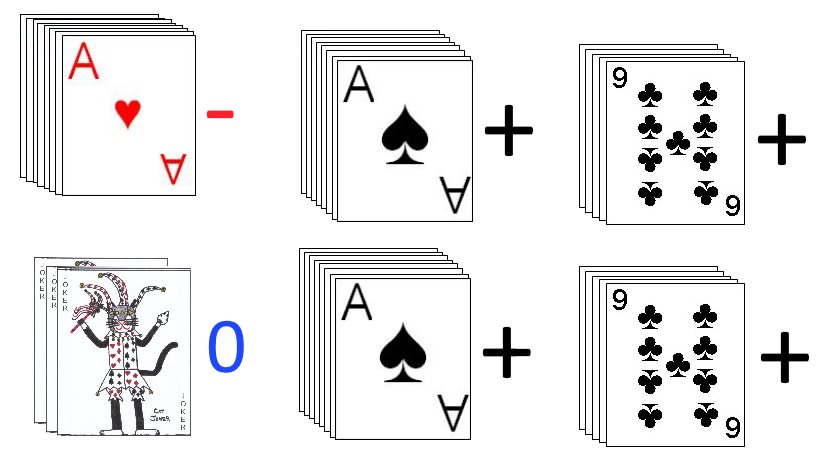
 Once the special deck required for this game has been constructed using the two standard decks, seating positions and the first dealer should be determined (unless this has been previously decided). A common method to do this is for all participants to draw a card from a shuffled deck. The players then select a seat at the table in the order of ranking of the cards they have drawn, from highest to lowest. The player who draws the highest card of all becomes the first dealer.
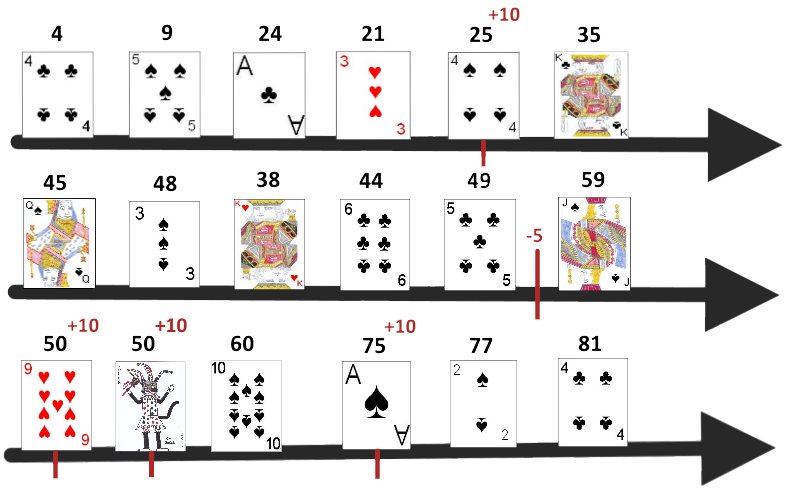
The designated dealer should thoroughly shuffle the deck and offer it to the player at his right to cut. After the cut, he should then begin dealing the cards around the table in a clockwise direction starting with the player at his immediate left. The cards are distributed one by one and face down. The number of cards will be directly dependent on the number of participants:
| Number of Players | Cards Dealt per player | Notes |
|---|---|---|
| 2 | 15 | The last two cards are dealt face-up to the table |
| 3 | 10 | Two cards remaining, set face-up on the table |
| 4 | 8 | All cards dealt out |
| 5 | 6 | Two cards remaining, set face-up on the table |
| 6 | 5 | Two cards remaining, set face-up on the table |
As will be noticed, in all but the four player game, there are two cards which are not dealt to the player. These two cards should thus be dealt face-up to the table and these two cards are used to start the count. The dealer should thus announce the sum total of these two cards, and the first player then plays his card, adding to this total.
The player to the immediate left of the dealer then has the turn first turn and the turns then rotate around the table in a clockwise direction. On a player's turn he plays one card to the center of the table. He should then announce the sum total of all the cards so far played to the center of the table (including the two initial cards played on the table, if any). To this end, each card in the deck thus has a summing value, as per the following chart:
|
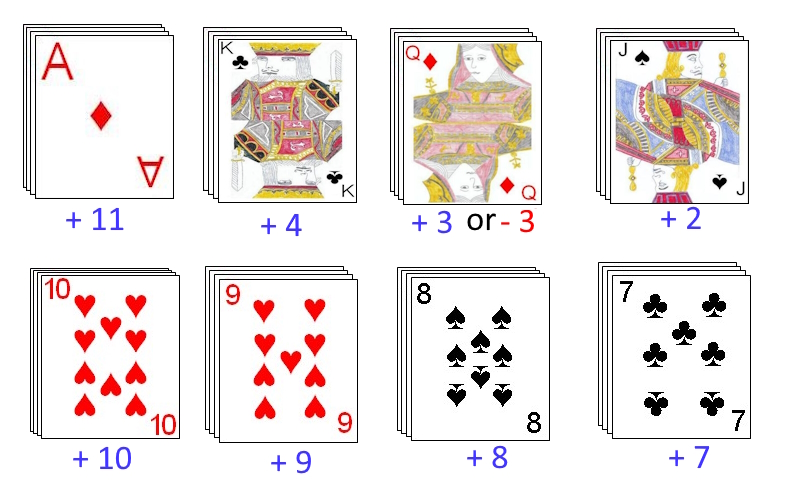 |
If a player plays a card on his turn that causes the total to exactly equal one of the totals 55, 66, 77, 88, 99 or 111 (called the "obstacles") that player earns one point. However, if a player causes the total to skip over one of these totals (either in adding or subtracting), that player loses one point instead. If the running total from the play of cards reached or exceeds 120, the cards in the center of the table are set aside, and the next player begins a new series, starting with 0.
Once the last card has been played, whichever player has managed to earn the most points is declared the winner (or the player with the least negative score, if all players have negative scores).