How to Play Chouine

Chouine is a two player, trick taking card game which is primarily played in a few specific areas in France (i.e. the Loire Valley). Variants for other numbers of players are sometimes played, which are described in the variants section of this page, below.

To play Chouine, one 32 card Piquet deck will be need. This deck can be created from a standard 52 card deck by removing all other cards from this standard deck save the cards of rank Ace, King, Queen, Jack, 10, 9, 8, and 7. The ranking of the cards as used in the game are as follows (from high to low): Ace, 10, King, Queen, Jack, 9, 8, 7.

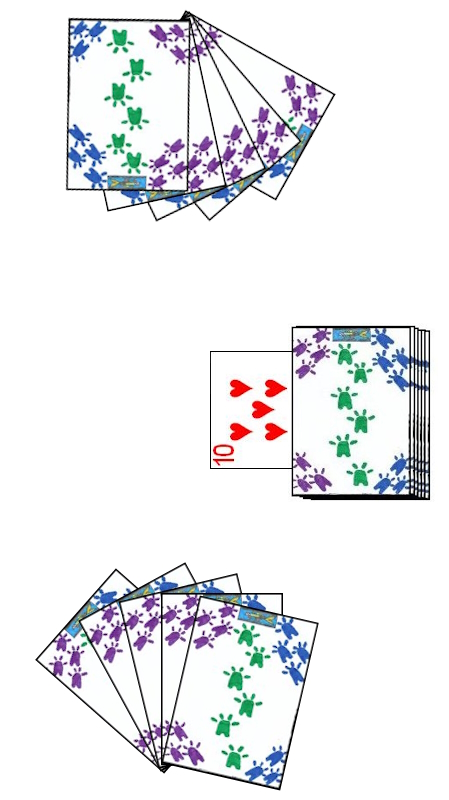
Example initial deal in Chouine To determine the first dealer, and the first choice of seats at the table, the usual method is for both players to draw a card from the shuffled deck, which has been spread face-down on the table. If both players draw cards of the same rank, they must draw again. Whichever player draws the lowest ranked card has the first choice of seats at the table and is set as the first dealer. After each hand, the role of dealer alternates amongst the two participants. A full game session (called a manche) is played over the course of several "points" or "parties", with each point or partie essentially being one deal. After each partie is completed, the first dealer of the next partie would be the opposing player to the player who dealt on the first partie.
The dealer for each hand should thus thoroughly shuffle the deck and then offer it to his opponent for the cut. After the cut the dealer then begins distributing the cards. He deals each player five face-down cards, one by one, starting with his opponent. The dealer then deals the next card face-up to the center of the table. The suit of this card sets the trump suit to be used for this hand (partie). He next places the remainder of the deck partially overlapping that trump designator card and at a 90 degree angle to it. This stock of cards is the talon.

Both players then pick up their hands to review the cards they have been initially dealt. The opponent of the dealer leads the first card to the first trick.

There are essentially two phases of this game, and during both phases the rules of play to each trick are different. The first phase continues as long as their are undrawn cards remaining in the talon. Once the talon has been exhausted, the second phase of play begins. Each trick consists of two cards, one played by both players.

Trick Play During First Phase: The leader to a trick may play any card remaining in their hand to start the trick. His opponent may then also play any card remaining in his hand to that same trick. Player's are not obligated to follow the suit led. If the trick contains any cards of the trump suit, the highest such card wins the trick. If the trick contains no cards in the trump suit, the highest card in the suit originally led to the trick wins it. The cards from the won trick should be placed in a face-down pile near the winner of said trick. The winner of the trick then draws the top card from the talon and his opponent draws the next. The winner of each trick then leads the first card to the next trick.

Trick Play During Second Phase: During the second phase, the rules for play to an existing trick change significantly. Once the last card has been thus been drawn from the talon (which will be the face-up trump suit designator card), the game switches to phase two. As in the first phase, the leader to a trick may play any card of choice remaining in their hand. However, his opponent is more limited in his options for play to that trick. If that player has a card in the suit originally played to the trick he must play it and if he has no cards in that suit, but has a card in the trump suit, he must play that card. If the card led to the trick was in the trump suit, the opponent must not only play a card of that same suit if they have one, but they must also play a higher card in that suit if they have such a card. If the player has no card in the suit originally led to the trick and no cards in the designated trump suit, he may play any card remaining in his hand. If the trick has any cards in the trump suit, the player of that card wins the trick. If no cards from the trump suit are found in the trick, it is won by the highest card of the suit originally led to that trick. The winner of the trick adds the cards from that trick in their face-down won tricks pile, and leads the first card to the next trick.

If a player during phase one finds that they have seven of the trump suit in hand, they may (but are not required to) exchange that card for the face-down trump designator card. This may not be done once there are only two cards remaining in the talon (one card being this trump designator card).

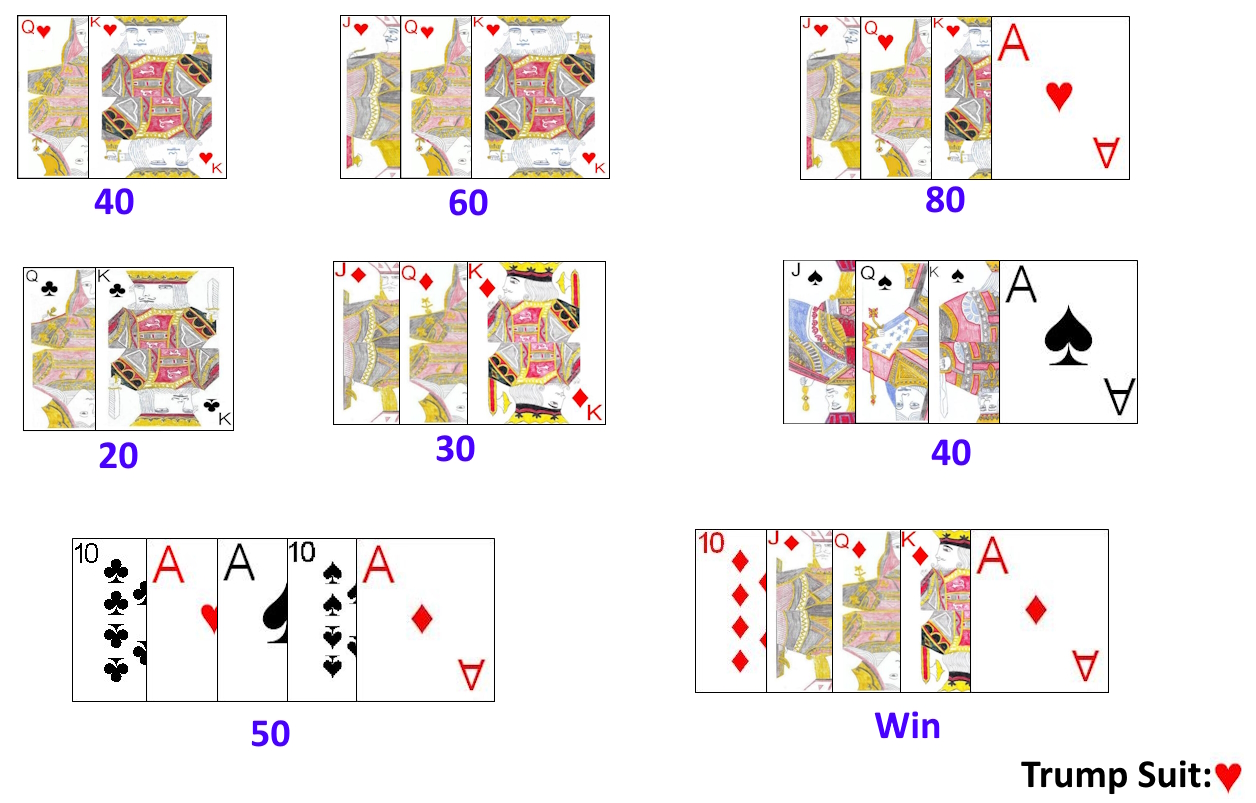
In addition, a player can score for certain special combinations of cards found in his hand. He does this immediately before playing one of the combination's constituent cards to a trick. The following are the valid combinations which can be announced and scored for during the game:
Scoring combinations in Chouine           
CombinationDescriptionScoring Value
Mariage (in trumps)The King and Queen of the trump suit40 Points
Mariage (non-trump)King and Queen both of the same suit (non-trump suit)20 Points
Tierce (in trumps)The King, Queen and Jack of the trump suit60 Points
Tierce (non-trump)A King, Queen and Jack, all of the same suit (non-trump suit)30 Points
Quarteron (in trumps)The Ace, King, Queen and Jack of the trump suit80 Points
Quarteron (non-trump)An Ace, King, Queen and Jack all in the same suit (non-trump)40 Points
Cinquante (or Quante)Having five cards in the ranks of ten and Ace, of any suit.50 Points
ChouineA King, Queen, Jack and ten all in the same suitImmediate Win

There can only be one combination declared in each suit on any specific game. For example, a player cannot score for the Tierce, and later, drawing the Ace, declare for the Quarteron. As a Cinquante may consist of multiple suits, the player can still declare and score for a Cinquante if they have declared other combinations, however each player may only score for a Cinquante once her hand (partie). The combinations may be declared and scored by a player at any time during the game, as long it's declared in playing one of the cards forming that combination in a trick, and as long as the player still has all cards forming the combination in hand.

If either player declares a Chouine, that player immediately wins the current partie, regardless of the score of both players. However, if both players declare a Chouine in the same trick, if one Chouine is in the trump suit, the player of that Chouine is declared the winner of the partie. If neither of those Chouines are in the trump suit, the leader to that trick (and thus the first to declare a Chouine) is the winner of the partie.

The winner of the last trick earns a bonus of 10 points (called dix de der). In addition to the points for last trick and combinations, each card in the deck has a specific point value, and a player earns a number of points based on the cards that player managed to win in tricks during the partie, as shown in the following chart:

CardPoint Value of Card
Ace11 Each
Ten10 Each
King4 Each
Queen3 Each
Jack2 Each
Nine, Eight, Seven0

After each partie has been completed, the players compare all scores they earned from that hand (combinations, last trick and card points captured). Whichever player has the higher total is declared the winner. If both players have the exact same score, neither player wins the partie, and a replacement partie is played. Cards with a value of 10 or higher are called brisques.

The first player to win two parties is considered to have won the manche. If each player has won one partie, the third partie (called la belle) is then played to determine the winner of the manche. Players usually consider a complete game to be the best of a number of manches (such as three).


Variations and Optional Rules

Additional Players: Chouine is sometimes played with more than two players. Thus, a variant has been designed for three and four players. The game is played similarly to the standard two player game, with the following differences: In all other aspects the two and three player variant is played identically to the standard two-player variant as described at the top of this page.

Copyright © 2015 CatsAtCards.com. All rights reserved.
[Main][Site Map][Glossary][Copyright Page]