 How to Play Kings in the Corner
Kings in the Corner is a fun multi player game that resembles solitare in many ways. During the course of the game, players attempt to deplete their hands by playing their cards to a tableau in the center of the table. The name of this game is sometimes shortened to just Kings Corner or Kings Corners.Kings in the Corner can be played by from two to six players. The game uses the standard 52 card pack with the cards ranking as follows, from highest to lowest: King, Queen, Jack, 10, 9, 8, 7, 6, 5, 4, 3, 2, Ace.
The first order of business in the game is to determine which player will be the first dealer. The choice of this first dealer can be accomplished in one of several ways, with cutting for high card a commonly used method.
 Once the dealer is selected, he deals the cards face down one at a time clockwise around the table until each player has seven. The player to the dealers immediate left receives the first card in the deal. After each hand the deal rotates around the table in the same clockwise direction.
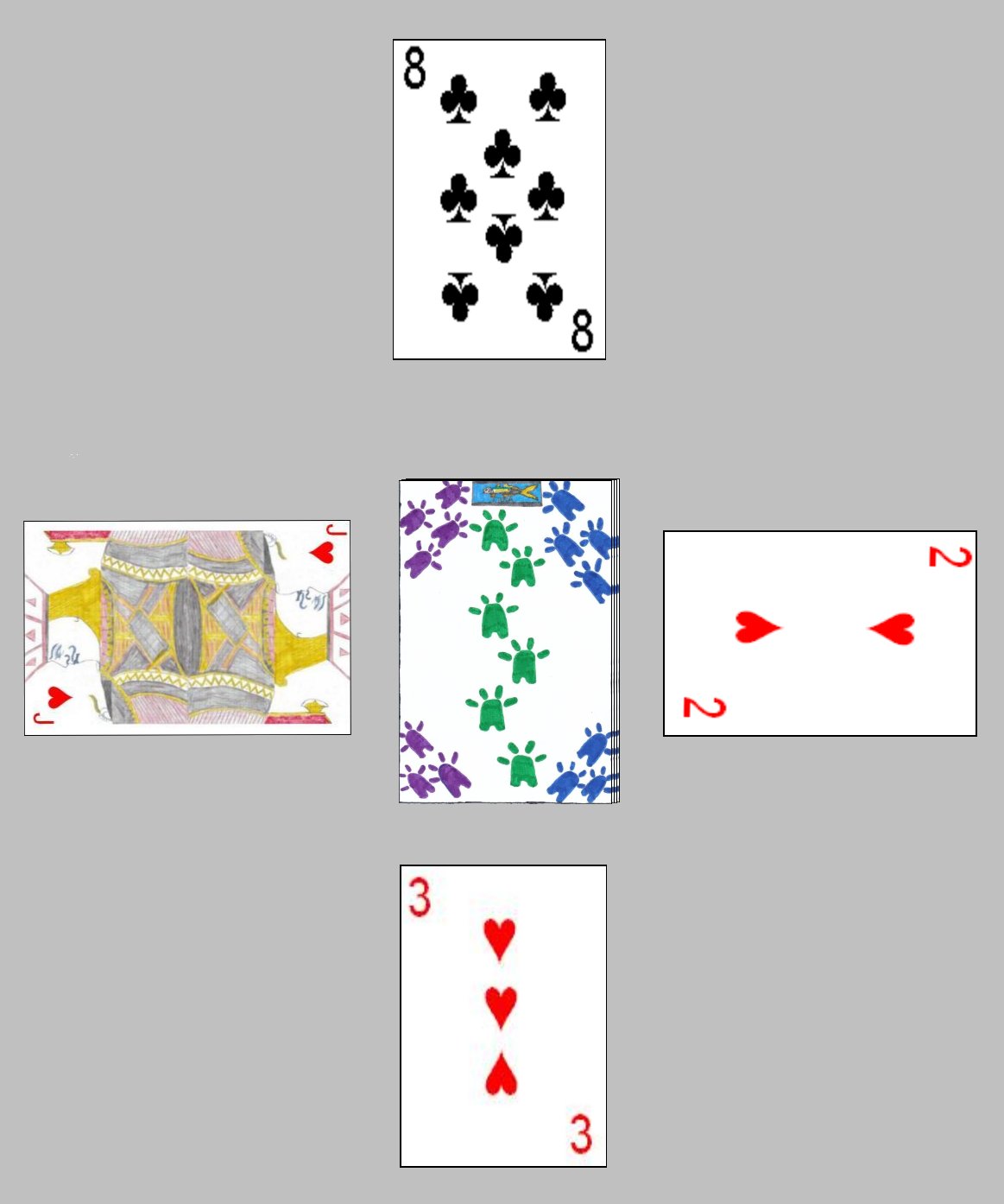
The dealer then creates a layout on the center of the table to begin the game, called the tableau. He places the draw pile face down in the center of the table. He then removes four cards from the stock pile and lays them face up around the stock pile to begin foundation piles. He places one at each side of the draw pile, at the four points of the compass, North, South, East and West. The diagram to the left shows an example of this initial layout. Obviously the identity of the specific cards dealt to the tableau would be different but the layout format should be the same.
After the layout is created, the player to the immediate left of the dealer plays first. To begin his turn a player first must draw a card from the center stock pile. After drawing he may make any of the following legal moves:
- If his hand contains any Kings he may immediately play them. Kings are played in the corners (angled between the four original foundation piles. These Kings start new foundations in the corners in which players can play cards to.
- If he has any card that is lower in rank than a card currently at the top of any of the foundation piles on the table, and the card is of the alternate color, he may play this card to the appropriate foundation pile. Thus, the foundation pile will be built in a downward ranking, alternating red and black cards. For instance, a red 9 can be played on any black 10.
- If, on the table, the bottom most card of any foundation pile is next down in rank from the top card of another foundation pile, he may move the entire pile to make one long descending, color alternating sequence.
- If, by making the above move, any of the four original foundation piles is empty (has no cards currently on it) the player may play any card of his choice in the spot.
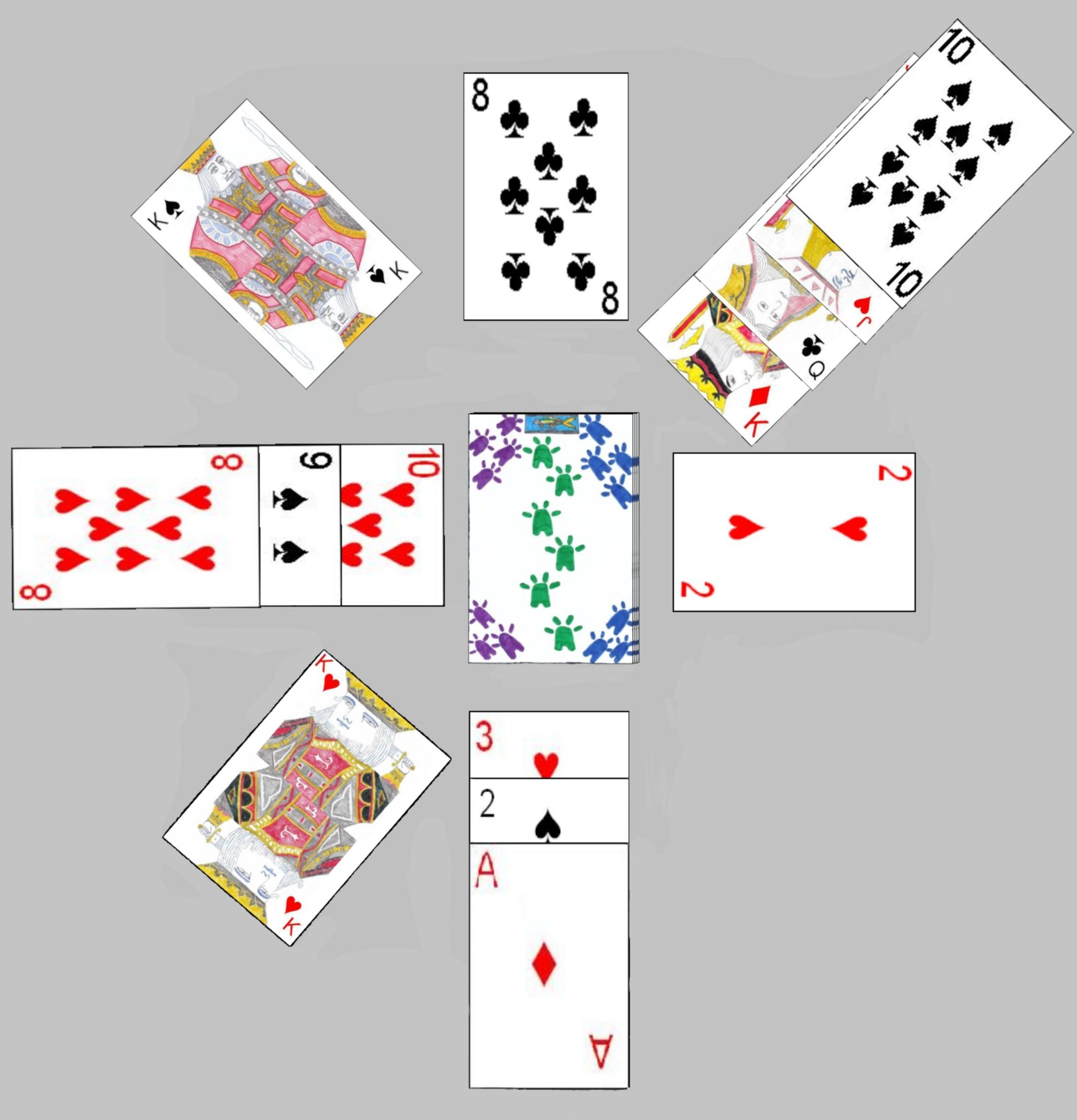 The player may continue to make any legal plays to the tableau as long as he can. As soon as a player is unable (or chooses not) to make further plays, they call pass and the turn passes to the next clockwise player. A player who has no moves after drawing a card can pass without making any playes to the tableau. The diagram to the right shows how the tableau might look with a game in progress.
The first player to play their last card to the center of the table is the winner of the hand and the other players each score points based on the cards remaining in their hands as follows:
- Each King left in a players hand has a value of ten points.
- All other cards left in a players hand have a value of one point each.
After each hand, the deal passes to the player to the last dealers immediate left. When any player reaches some previously agreed upon limit, often 25, the game ends and the player with the lowest score is declared the winner. If two or more players tie for the low score they are considered co-winners of the game.